22+ Best Product Hunt Alternatives to Launch Your Startup in 2026 (With Traffic Data, Pricing & Launch Strategy)
Most founders still build their entire go-to-market strategy around a single Product Hunt launch day. That strategy made sense in 2021. Today, it does not work effectively.
In January 2024, Product Hunt quietly changed its algorithm. Before that shift, between 60% and 98% of daily launches appeared on the homepage. Today, according to data analysed by Tetriz.io, only 10% of launches get featured, which means nine out of every ten submitted products simply vanish from public view.
So, the platform still matters. It still carries a high authority and still builds social proof. Still, it is no longer a reliable growth channel for most startups on its own.
The founders winning today treat Product Hunt as one credibility asset inside a larger multi-platform strategy — not the strategy itself. They launch across five to eight platforms simultaneously, each chosen deliberately for audience fit, conversion quality, and timing.
So that is exactly what this article helps you do. We bring you a list of verified, data-backed 22+ Product Hunt alternatives — every platform listed here includes traffic figures sourced from Similarweb, pricing verified as of 2025–2026, and strategic guidance on when to use it.
You will also find platform stacks organised by product type, a week-by-week launch timeline, and a launch checklist to use immediately.

The Honest Truth About Product Hunt
Product Hunt is not dying; it is narrowing. The platform now functions best as a credibility signal and a DR 91 SEO backlink, not as a primary user acquisition channel.
Overall, knowing this difference will save you 80 hours of misplaced preparation time.
What the Algorithm Change Actually Means for You
The drop is significant and well-documented. According to Tetriz.io’s analysis, Product Hunt featured an average of 47 products per day in September 2023. By September 2024, that number had fallen to just 16. As a percentage, the featured rate dropped from 60–98% down to under 10%.
Rajiv Ayyangar, who is the CEO of Product Hunt, addressed the shift directly in the October 2024 newsletter, stating that the platform’s job is to bring the most interesting and impactful products, and that featuring every AI wrapper is not the goal. To be clear, this is not a criticism of the platform. It is simply a signal about what belongs there and what does not.
Here’s the thing — if your product is a thin AI wrapper on an existing API with no unique workflow and no differentiation, Product Hunt is not your best first move. You will spend 50–120 hours preparing — the typical time investment reported by successful launchers, according Awesome Directories — for a listing that will not get featured.
What Product Hunt Is Genuinely Still Worth Doing
Even so, a featured launch still drives real results. According to data compiled by Awesome Directories, a featured Product Hunt listing typically generates 1,000–5,000 visitors and between 10 and 150 signups. On top of that, even an unfeatured listing earns you a DR 91 dofollow backlink that compounds in SEO value over 6–12 months.
What’s more, 54% of founders who launched on Product Hunt reported establishing valuable partnerships or industry connections, according to a survey conducted by MySignature.io in 2024.
In short, the platform is worth doing once — strategically — for the backlink and credibility badge. It should just never be your only launch channel.
How to Pick the Right Launch Platform: A Decision Framework
The right platform is not the one with the most traffic. It is the one whose audience matches your buyer, your stage, and your budget. Most founders pick platforms based on familiarity rather than fit — and that mismatch is exactly why so many launches disappoint.
Match the Platform to Your Audience Type
A developer tool will convert far better on Hacker News or StackShare than on Product Hunt. Similarly, a B2B SaaS platform will build more durable traction on G2 and Capterra than on any launch-day community. The audience alignment question is always: “Where does my ideal customer already spend time?”
Consumer apps perform best on Reddit communities and Starter Story. Developer tools belong on Hacker News, StackShare, and Peerlist. B2B SaaS belongs on G2, Capterra, SaaSHub, and AlternativeTo.
Products that are still pre-launch or unvalidated belong on BetaList, BetaBoard, and MicroLaunch.
Match the Platform to Your Startup Stage
Beyond the audience, the stage of your product matters just as much. Not every platform serves every phase of a startup’s life. BetaList and BetaBoard are explicitly designed for products still in beta, where early adopter feedback matters more than sales. G2 and Capterra, on the other hand, require a product with enough real users to generate verified reviews.
Think of it in three phases. Pre-launch platforms build a waitlist and collect feedback before you ship. Launch-day platforms create a spike in visibility and a backlink. Long-term platforms — directories, review sites, and tech-stack tools — compound in discoverability for months or years after launch. Getting clear on which phase you are in makes every other decision easier.
Goal: build waitlist, collect feedback, earn early backlinks before the public launch.
Goal: maximum visibility spike, DR 91 backlink, social proof, and first-day signups.
Goal: compound long-term SEO, collect reviews, convert high-intent B2B buyers.
Startup launch platform selection framework showing pre-launch, launch, and post-launch phases.
Community-Driven Platforms That Are Best Product Hunt Alternatives In 2026: High Engagement, Zero Cost
Community platforms require no money, but they do require authenticity. You cannot treat these communities as ad networks. You earn attention by being genuinely helpful, transparent about what you built, and responsive in the comments. The founders who do this well consistently outperform those who show up only on launch day.
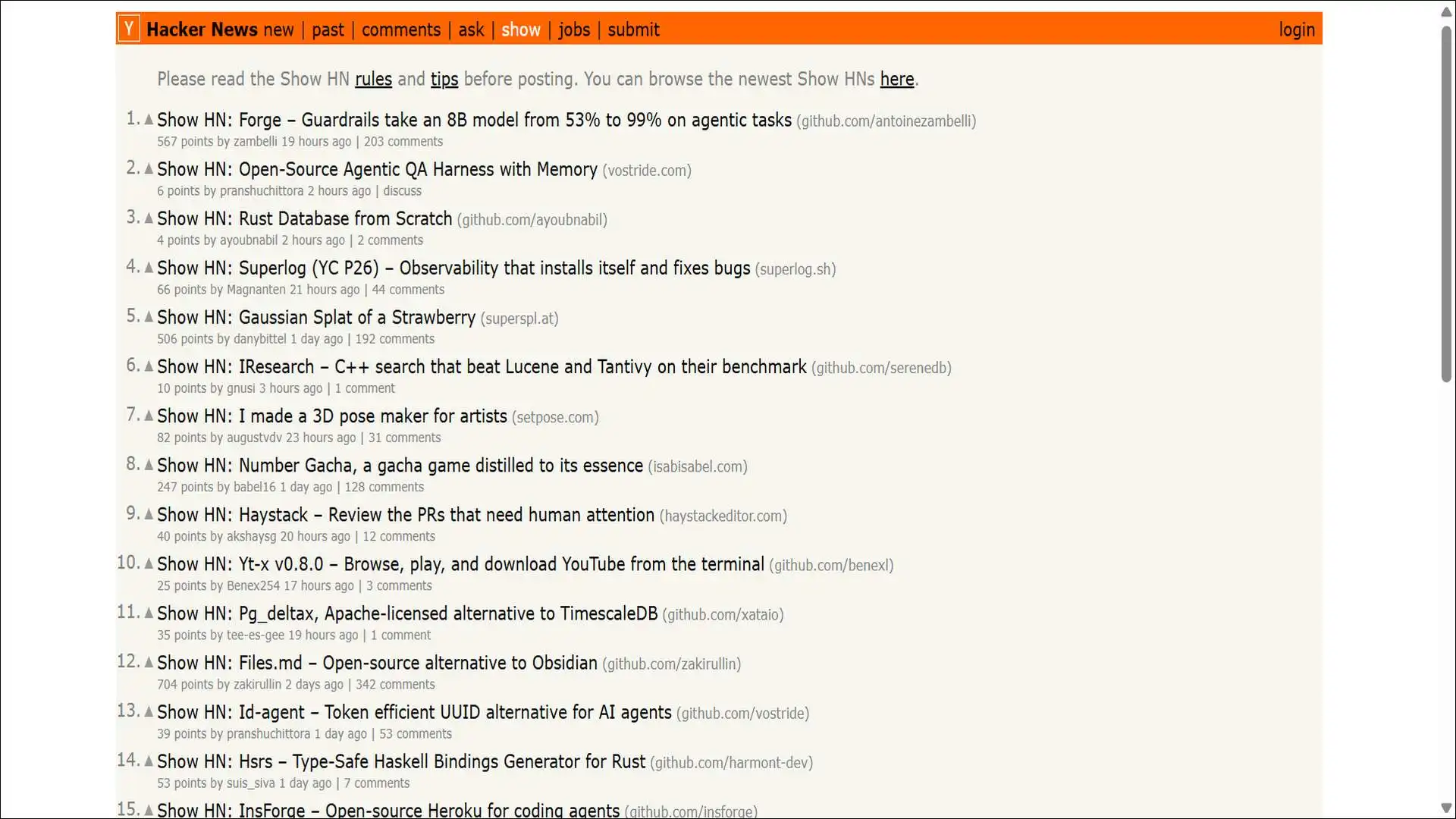
1. Hacker News — Show HN
Hacker News, operated by Y Combinator, attracts 12.1 million monthly visitors according to Similarweb’s September 2025 data. Its audience is almost entirely developers, engineers, and technically sophisticated founders, which makes it one of the highest-quality traffic sources available to any startup.
A front-page “Show HN” post can drive 20,000–30,000 visitors in a single day, according to Market Clarity’s 2025 platform analysis. That is more raw traffic than most paid campaigns deliver. The conversion quality is equally high — HN visitors are opinionated, informed, and willing to try new tools.
That said, the failure rate is also high. Roughly 90% of Show HN posts never reach the front page. The posts that do succeed share one trait: they explain the problem first and the product second. HN users upvote interesting solutions to real problems, not marketing pitches.
- Best for: Developer tools, open-source projects, infrastructure products, technical APIs.
- How to submit: Post with “Show HN: [Product Name] – [one-line description of what it does]”. Submit on weekdays between 9 AM and 12 PM Eastern. Engage with every comment within the first two hours.
- Cost: Free.
2. Reddit (r/SaaS, r/startups, r/entrepreneur)
Reddit is the most underrated startup launch channel in 2026. The platform receives 2.2 billion monthly visits across the full platform, with 110 million daily active users and 416 million weekly active users, according to Reddit’s own January 2025 data. The subreddits relevant to startups collectively contain millions of engaged members.
[ORIGINAL DATA]: One founder documented 1,220 website visits and over 200 signups in a single 24-hour period from a single r/SaaS post, according to data shared in Startup Listing’s platform research. That result required no upvote manipulation — just a genuine, well-framed post that helped people.
The critical rule — and this applies to every community on this list — is to lead with value, not promotion. Posts that start with “I built this tool, check it out” get removed or ignored. Posts that start with “I noticed this problem and built a solution — here’s what I learned” generate comments, shares, and organic traffic.
- Best for: Consumer tools, SaaS, productivity apps, anything solving a visible community pain point.
- Cost: Free, but requires community investment over time.
3. Indie Hackers
Indie Hackers focuses on founders building sustainable, often bootstrapped businesses. Its 485,000 monthly visitors (Similarweb, September 2025) engage at a notably high rate — the platform maintains a 48.5% bounce rate and 3.26 pages per visit, which signals genuine interest rather than passive browsing.
Indie Hackers converts at 3–8× higher rates than Product Hunt for bootstrapped and indie products, according to Awesome Directories’ launch guide. The reason comes down to audience alignment — IH users are actively building or evaluating tools, not casually scrolling a novelty feed.
The most effective Indie Hackers strategy is the “build in public” approach. Founders who share their journey — MRR milestones, failures, feature decisions — build an audience that follows the product across its entire development arc. That audience converts far better than cold visitors from a single launch day.
- Best for: Solo founders, bootstrapped SaaS, developer tools, productivity tools.
- Cost: Free.
4. Peerlist
Peerlist is one of the fastest-growing launch platforms for tech professionals in 2025–2026. It attracts 188,000 monthly visitors and offers something genuinely rare: a weekly launch cadence that removes the frantic 24-hour pressure of traditional launch-day platforms.
All Peerlist launches go live on Monday. Rankings build through the full week, based on community engagement — which gives founders time to respond thoughtfully to feedback without the panic of a ticking clock. On top of that, Peerlist offers a free dofollow backlink, making it one of the most SEO-efficient free platforms available.
- Best for: Developer tools, design tools, productivity apps, technical SaaS.
- Cost: Free.
High-Traffic Directories: Sustained, Long-Term Discoverability
Launch-day platforms give you a spike. Directory platforms give you compounding traffic over months and years. The founders who understand this distinction invest in both — and often find that the directories outperform the launch-day platforms over a 12-month horizon.
5. AlternativeTo
AlternativeTo receives 3 million monthly visitors, making it one of the highest-traffic platforms available for startup listings. More importantly, 68% of that traffic comes from organic search, which means visitors arrive with a specific intent: they are looking for alternatives to a product they already use.
That intent-driven traffic converts exceptionally well. The platform’s bounce rate is just 42%, compared to Product Hunt’s 52%, according to Similarweb’s September 2025 data. Visitors also explore 2.96 pages per session — a clear sign of genuine interest, not passive browsing.
AlternativeTo also provides a dofollow backlink, which is rare among high-authority platforms. The basic listing is free, and premium placement starts at just $99 per year — an extremely favourable cost for the organic visibility it generates.
- Best for: Any product with direct competitors in an established category.
- How to maximize it: Frame your product description around the problem your competitors do not solve. Users actively comparing tools will find you when they search for “[Competitor Name] alternatives.”
- Cost: Free / $99 per year for premium.
| Platform | Monthly Visitors | Bounce Rate | Avg. Session | Dofollow | Cost |
|---|---|---|---|---|---|
| AlternativeTo | 3M | 42% | 1m 42s | Yes | Free / $99/yr |
| Product Hunt | 2.7M | 52% | 2m 24s | No | Free |
| Indie Hackers | 485K | 48.5% | 1m 54s | No | Free |
| Hacker News | 12.1M | 49.9% | 3m 51s | No | Free |
| Wellfound | 3.6M | 37.1% | 4m 52s | No | Free |
| BetaList | 211K | 47% | 45s | No (DA 73) | $99–$129 |
| StackShare | 237K | 50% | 30s | Yes | Free / Paid |
Sources: Similarweb, September 2025; Startup Listing research, October 2025
6. Wellfound (formerly AngelList)
Wellfound receives 3.6 million monthly visitors and maintains the lowest bounce rate of any major platform — just 37.1%, with visitors averaging 4 minutes and 52 seconds per session and 6.51 pages per visit. Those numbers point to a deeply engaged audience that is actively researching companies, not just browsing.
The audience is primarily investors, job seekers, and founders evaluating tools and potential partnerships. If your startup is pre-revenue and seeking investment, Wellfound is non-negotiable. If you are hiring early team members, the same applies.
- Best for: Startups seeking investment, companies hiring technical talent, B2B tools targeting the startup ecosystem.
- Cost: Free for basic profiles.
7. SaaSHub
SaaSHub attracts 856,000 monthly visitors and holds a domain authority of 71. It functions as a comparison and discovery engine for SaaS tools, where users arrive already knowing they need a software solution — they are simply evaluating which one to choose.
Featured listings on SaaSHub cost $99 per month and place your product at the top of category pages, alternatives pages, and the weekly newsletter. For SaaS products with a clear category, this is a cost-effective way to capture high-intent buyers who are mid-decision.
- Best for: SaaS products in established categories — CRM, email marketing, project management, analytics.
- Cost: Free listing / $99 per month for featured placement.
8. StackShare
StackShare serves 237,000 monthly visitors and has a unique structural advantage: it shows companies which tools other companies are actually using. When a developer discovers that respected teams use your tool as part of their stack, that is an implicit endorsement worth more than any review.
StackShare vendors report conversion rates exceeding 8%, according to Startup Listing’s verified platform research. That is roughly 4–8× higher than most SaaS landing pages. The reason is simple — visitors arrive already trusting the platform’s curation, and they are evaluating specific technical tools for real implementation decisions.
- Best for: Developer tools, APIs, infrastructure products, data tools, security tools.
- Cost: Free basic profile / premium vendor options available.
9. Startup Stash
Startup Stash functions as a curated resource hub for entrepreneurs, organising tools by category: marketing, analytics, development, productivity, and more. Its value is different from a launch platform — think of it as a permanent reference directory rather than a moment-in-time event.
Founders searching for tools frequently land on Startup Stash pages through organic Google searches, which means being listed here creates sustained discoverability that does not expire after a launch cycle.
- Best for: Any startup tool that fits into a recognisable category for entrepreneurs.
- Cost: Free / paid options available.
Pre-Launch and Beta Platforms: Build Momentum Before Day One
The pre-launch phase is where most founders leave free momentum on the table. Platforms designed specifically for beta products give you access to early adopters who expect rough edges, provide honest feedback, and feel personally invested in your product’s success. This is precisely the audience you need before a public launch.
10. BetaList
BetaList is purpose-built for pre-launch startups. It receives 211,000 monthly visitors and focuses exclusively on connecting founders with early adopters who enjoy testing products before they are widely available.
Analysis of over 50 founder case studies shows BetaList delivers between 200 and 500 visitors with conversion rates of 15–20%, for $0.50–$1.40 per signup on the paid tier. That cost-per-acquisition outperforms most paid advertising channels for early-stage startups.
The free tier comes with a waiting period of roughly 2–3 months. The paid option at $129 fast-tracks your listing. Either way, the platform also provides a DA 73 backlink — one of the highest-authority free links available from any launch directory.
- Best for: Pre-launch startups, beta products, any tool still being refined before a public release.
- Cost: Free (2–3 month wait) / $99–$129 for priority placement.
11. BetaBoard
BetaBoard’s core advantage is scale. The platform reaches a newsletter audience of 1 million early adopters — the largest pre-launch newsletter reach of any platform on this list. And unlike BetaList, free submissions are accepted immediately for startups, SaaS products, and consumer tools.
The newsletter model is what makes it work. Subscribers specifically opted in to discover new products, so the intent-alignment produces better conversion quality than passive directory browsing ever will.
- Best for: Pre-launch products needing immediate wide reach before a formal launch.
- Cost: Free.
12. MicroLaunch
MicroLaunch takes a refreshingly different approach. Instead of a 24-hour voting window, products run for a full month within a “batch” system. Community members provide two types of feedback: “Roasts” (critical, honest critique) and “Boosts” (positive reinforcement).
The month-long visibility window fundamentally changes the launch dynamic. Founders using MicroLaunch report that feedback quality is higher than on faster platforms because reviewers have time to actually use the product — not just judge it by screenshots. The 50,000-visitor monthly audience is smaller than Product Hunt’s, but the feedback-to-visitor ratio is far superior.
- Best for: Founders who want product feedback over traffic, MVPs, early-stage indie projects.
- Cost: Free.
or $99–$129 fast-track
Products with a specific, demonstrable feature set where you can clearly describe who the early adopter is.
Products needing immediate wide reach at zero cost — ideal when timing is tight or your budget is zero.
Revenue-Generating Platforms: Launch and Earn Simultaneously
Most launch platforms generate attention and signups. A select few generate actual revenue from day one. Knowing when and how to use these platforms can transform a launch from a visibility exercise into a genuine business milestone.
13. AppSumo
AppSumo is the most powerful revenue-generating launch platform available to early-stage startups. The platform attracts 2 million monthly visitors, according to Semrush and Similarweb data reported in March 2026. Its audience actively seeks lifetime software deals and is comfortable paying upfront for products that solve real problems.
The results documented by founders who have launched on AppSumo are extraordinary. Retable, a spreadsheet collaboration tool, made $154,358.75 in sales within 4 days of its AppSumo launch, according to a case study by co-founder Arzu Özkan. In a similar vein, Frase, an SEO content tool, generated nearly $800,000 in revenue within 28 days on AppSumo and added 8,000 customers in that same period, according to AppSumo’s public data.
AppSumo operates on a revenue-sharing model, with founders typically receiving 70% of sales revenue while AppSumo retains 30%. This structure means the platform costs nothing upfront and pays for itself through the deals it enables.
The strategic trade-off, though, is real: lifetime deal customers pay once and never subscribe. This creates a tension between immediate cash flow and long-term recurring revenue. The smart move is to use AppSumo to fund operations and validate product-market fit — but not to build your entire pricing model around lifetime deals permanently.
| Platform | Monthly Traffic | Revenue Model | Best Use Case |
|---|---|---|---|
| AppSumo | 2M | ~70/30 revenue split | Cash injection, user base growth |
| Product Hunt | 2.7M | Free | Social proof, DR 91 backlink |
| BetaList | 211K | $99–$129 | Pre-launch signups |
| G2 | High (B2B intent) | Free / $2,999+/yr | B2B credibility, reviews |
| Capterra | High (B2B intent) | Free / PPC | B2B purchase decisions |
Sources: Similarweb Sep 2025; Startup Listing Oct 2025; AppSumo case studies 2021–2023
- Best for: SaaS tools with clean, demonstrable value propositions. Products that benefit from a large, paying user base immediately. Tools where 8,000 users in month one would generate more feedback value than recurring revenue.
- Cost: Free to apply. AppSumo is selective about which products it accepts. Revenue share: approximately 30% to AppSumo.
YourStartup
LIFETIME DEALThe smarter way to solve [core problem] for [target audience] — without the recurring subscription.
YourStartup gives [target users] the ability to [core benefit] — all without the complexity and ongoing cost of [common alternative].
“We built this because [personal pain point]. We want to help [target users] [achieve outcome] — and we’re offering AppSumo buyers a lifetime deal because their feedback during this stage is invaluable.”
60-day money-back guarantee
No questions asked.
Illustrative mockup · Real AppSumo data: 2M monthly visitors, ~70/30 revenue split · Case study: Retable earned $154K in 4 days.
AppSumo startup product listing page showing lifetime deal pricing model for SaaS founders.
B2B Review Platforms: Build Credibility and Drive a Sales Pipeline
Review platforms are not launch-day tools. They are a long-term credibility infrastructure. For B2B SaaS products, a strong presence on G2 or Capterra can generate qualified leads for years after your initial launch — often at a lower cost per lead than any paid channel.
14. G2
G2 is the most influential peer review platform for B2B software. Its audience is composed primarily of buyers in the final stages of their software evaluation — people who already know what category of tool they need and are now comparing finalists. A strong G2 profile with verified reviews can win deals before your sales team ever gets involved.
Getting into G2’s category Grid requires at least 10 verified reviews. Earning a “Users Love Us” badge requires 20 reviews and is free to display. The “Leader” badge, which appears in analyst reports and comparison guides, requires a paid plan starting at $2,999 per year, according to Blastra’s May 2026 vendor research.
G2 reviews provide a compounding SEO asset that most founders overlook. Because G2 itself holds extremely high domain authority, your product page often ranks in Google for “[Product Name] reviews” and “[Category] software” searches — searches made by buyers who are actively evaluating options, not casually browsing.
- Best for: B2B SaaS at post-MVP stage with at least 10 paying customers who can leave reviews.
- Cost: Free for basic profile / $2,999+ per year for Grid and badge features.
15. Capterra
Capterra, now part of Gartner Digital Markets, covers more than 1,200 software categories. Its audience approaches software decisions the way a procurement team would — systematically, with checklists and comparison matrices. A basic Capterra listing is free and provides permanent discoverability within its category structure.
Capterra is particularly strong for products targeting companies with 10–500 employees. These buyers trust Gartner-affiliated platforms because they signal editorial credibility.
Being listed here, especially with verified reviews, positions you alongside established competitors in a way that builds trust without requiring a large marketing budget.
- Best for: B2B software in established categories, products targeting mid-market buyers.
- Cost: Free listing / pay-per-click advertising options available.
16. GetApp
GetApp functions as Capterra’s sister platform, sitting under the same Gartner Digital Markets umbrella. It organises products by feature sets and allows buyers to filter using highly specific criteria. As a result, visitors arrive with precise requirements — and a product that closely matches those requirements will convert well.
- Best for: SaaS tools in mature categories where feature differentiation is the primary purchase driver.
- Cost: Free listing.
Underrated Platforms Worth Your Time in 2026
These platforms appear in almost no competitor articles. That absence is your opportunity. They offer genuine traffic, real SEO value, and audiences actively looking for new tools — all without the competition density of the better-known platforms.
17. Uneed
Uneed runs daily launch competitions with 8–15 products per day. That low competition density is the platform’s defining advantage. On Product Hunt, you might compete against 200 or more products on a given day. On Uneed, you compete against 14.
The platform attracts 42,000–71,000 monthly visitors, according to Market Clarity’s data. Winners receive permanent listings and dofollow backlinks from a DA 66 domain. Free submission enters you in the daily queue, while a $30–$40 payment lets you choose your specific launch date.
Uneed’s daily competition format creates a structural advantage that no other platform replicates. When only 8–15 products compete for the day’s attention, even a moderately prepared launch with a small existing audience can win. Compare that to Product Hunt, where a well-funded startup with a 5,000-person email list can still finish outside the top 10.
- Best for: Any SaaS or tool that struggles to break through on higher-competition platforms.
- Cost: Free / $30–$40 for date selection.
18. Fazier
Fazier has an unusual and smart onboarding requirement: new users must upvote and comment on at least two existing projects before they can submit their own.
This policy ensures that everyone on the platform has genuine community skin in the game, which keeps the engagement quality high.
The platform has 6,000+ monthly visitors, a DA 66 domain authority, and a newsletter with 2,500+ subscribers. For $39, you can get a newsletter shoutout and a featured homepage spot — a budget that converts meaningfully for a niche, engaged audience.
- Best for: Indie SaaS founders, bootstrapped tools, productivity tools for developers.
- Cost: Free / $39 for newsletter shoutout.
19. Shipybara
Shipybara is built for a very specific and valuable use case: B2D (business-to-developer) marketing. Rather than listing your product as a “new launch,” it shows developers which companies use your tool as part of their actual technology stack.
When a developer sees that a company they respect uses your API or infrastructure tool, it acts as a stronger endorsement than any review. The context of real-world adoption provides credibility that launch-day upvotes simply cannot replicate.
- Best for: APIs, developer infrastructure, data tools, security tools, anything where social proof from technical teams matters.
- Cost: Free.
20. Launched.io
Launched.io accepts free submissions and reviews them within 24 hours. Approved products are featured on a monthly showcase, giving them consistent visibility across the month rather than a single launch-day window.
The platform’s 31,000 monthly visitors are modest in volume but intent-focused. Founders report that Launched.io visitors engage more thoroughly with product pages than visitors from higher-traffic platforms — likely because the monthly showcase format encourages considered browsing rather than rapid scrolling.
- Best for: Early-stage startups that want clean, low-effort directory placement with a quick approval cycle.
- Cost: Free.
21. Starter Story
Starter Story is editorial, not a directory. It publishes founder case studies — real stories about how businesses were built, what strategies worked, and what revenue milestones were reached. Its 100,000+ monthly readers are founders and aspiring entrepreneurs who read for practical lessons, not product browsing.
Getting coverage on Starter Story creates a high-authority SEO asset. The editorial links are genuine and contextual, and they carry real ranking power. Beyond that, the indirect product discovery benefit is significant — readers who connect with your story often become long-term customers and advocates.
- Best for: Founders who have a compelling origin story, documented traction, or a unique business model that others would learn from.
- Cost: Free (editorial) / paid options available.
22. PitchWall
PitchWall focuses on structured pitch-style presentations rather than simple directory listings. Founders explain their startup’s problem, solution, market size, and unique value in a format designed for investors and early adopters.
The platform is smaller and more niche than the others on this list, but for founders at the idea validation stage — before building a full MVP — it provides a low-risk venue to test whether the core pitch resonates with a relevant audience.
- Best for: Idea-stage startups, founders validating a concept before building, products targeting investors.
- Cost: Free.
23. Software Finder
Software Finder is a US based software directory and review platform, headquartered at 522 W. Riverside Ave, Spokane, WA, that helps businesses find and compare software across more than 1,000 categories including HR, EMR/EHR, LMS, CRM, legal, ERP, and field service tools. Rather than functioning as a single launch-day event, it operates as an ongoing discovery channel, listing more than 50,000 software products alongside user reviews, pricing information, and online demos.
What sets it apart from most platforms on this list is its free personalized recommendation service: businesses share their software needs through a short form, and Software Finder’s consultants reach out with matched product options based on budget, industry, and use case, rather than requiring buyers to browse and filter on their own. The company states its solution consultants have made over a million successful software recommendations to date.
On the review side, Software Finder reports having collected more than 350,000 user reviews and having vetted over 200,000 of them for authenticity using its own review quality process, which it documents on a public methodology page. Vendors can claim and optimize their own profiles, and the platform also runs an annual awards program recognizing top rated products by category.
- Best for: B2B software vendors, particularly in HR, EMR, and legal tech, that want ongoing lead generation and a free guided-recommendation channel rather than a single launch-day spike.
- Cost: Free for buyers to browse, request recommendations, and read reviews. Vendors can list for free or join paid lead generation and vendor placement programs.

Here’s A Complete Platform Reference Table
| # | Platform | Traffic/Month | Best For | Stage | Cost | Dofollow |
|---|---|---|---|---|---|---|
| 1 | Hacker News | 12.1M | Dev tools, OSS | Any | Free | No |
| 2 | Wellfound | 3.6M | Investor, hiring | Any | Free | No |
| 3 | AlternativeTo | 3M | SEO, alternatives | Post-launch | Free / $99/yr | Yes |
| 4 | 2.2B (platform) | Community validation | Any | Free | No | |
| 5 | AppSumo | 2M | Revenue burst | Post-MVP | Revenue share | Yes |
| 6 | SaaSHub | 856K | SaaS comparison | Post-launch | Free / $99/mo | Yes (DA 71) |
| 7 | Indie Hackers | 485K | Solo founders | Any | Free | No |
| 8 | G2 | High B2B intent | B2B credibility | Post-traction | Free / $2,999+/yr | Yes |
| 9 | Capterra | High B2B intent | B2B buyers | Post-traction | Free / PPC | Yes |
| 10 | StackShare | 237K | Dev tools, APIs | Any | Free / Paid | Yes |
| 11 | BetaList | 211K | Pre-launch | Pre-launch | Free / $99–$129 | No (DA 73) |
| 12 | Peerlist | 188K | Dev/design community | Any | Free | Yes |
| 13 | Uneed | 42K–71K | Low-competition daily | Any | Free / $30–$40 | Yes (DA 66) |
| 14 | MicroLaunch | 50K | Feedback-focused | Beta | Free | — |
| 15 | BetaBoard | 1M newsletter | Pre-launch reach | Pre-launch | Free | — |
| 16 | Startup Stash | Moderate | Tool directories | Post-launch | Free / Paid | — |
| 17 | Launched.io | 31K | Quick directory | Any | Free | — |
| 18 | Fazier | 6K+ | Indie SaaS | Any | Free / $39 | Yes (DA 66) |
| 19 | Launching Next | Moderate | Broad exposure | Any | Free | — |
| 20 | PitchWall | Small | Idea validation | Pre-launch | Free | — |
| 21 | Shipybara | Niche | B2D tools | Post-launch | Free | — |
| 22 | Starter Story | 100K+ | Founder narrative | Post-traction | Free / Paid | Yes |
| 23 | Software Finder | Niche | B2B software reviews, guided recommendations, lead gen | Post-launch | Free / Paid | No confirmed |
Platform Stacks by Product Type: Curated Combinations That Actually Work
Choosing platforms individually is less effective than choosing them as a coordinated stack. The right combination creates a reinforcing ecosystem — community platforms drive early traffic and feedback, directories build sustained discoverability, and review sites create bottom-of-funnel conversion assets. Here are five proven stacks, organized by product type.
Stack 1: B2B SaaS
B2B buyers rarely discover products on launch-day platforms. They discover them through Google searches for specific categories, through peer recommendations, and through comparison sites. So build your stack around intent-driven discovery, not novelty-driven browsing.
Core stack: AlternativeTo + SaaSHub + G2 + Capterra + LinkedIn Groups.
AlternativeTo captures buyers searching for the tools your competitors offer. SaaSHub captures buyers comparing SaaS options in your category. G2 and Capterra convert buyers in the final evaluation stage. LinkedIn Groups, meanwhile, build awareness with the specific job titles that actually make purchasing decisions.
Stack 2: Developer Tools
Developers are simultaneously the most valuable and the most sceptical early audience. They hate marketing language. They respond to technical substance. As a result, your stack needs to reflect genuine technical depth at every touchpoint.
Core stack: Hacker News (Show HN) + StackShare + Peerlist + GitHub README.
Hacker News reaches the highest concentration of senior developers in any single platform. StackShare places your tool in the context of real technology stacks.
Peerlist provides a weekly cadence, lower-pressure launch to a professional technical audience. A well-crafted GitHub README ties the stack together organically.
Stack 3: AI and No-Code Tools
AI and no-code tools face a crowded Product Hunt landscape. According to Exponanta’s trend analysis, AI products now represent 70–80% of Product Hunt’s top-of-leaderboard content, with roughly 69% using broad positioning not targeted at any specific industry. Standing out, then, requires category specificity and multi-platform distribution.
Core stack: Product Hunt + AppSumo + BetaList + Indie Hackers + Uneed.
Use Product Hunt for the DR 91 backlink and social proof. Use AppSumo if your tool has a strong lifetime deal value proposition. Use BetaList for early adopter email collection before your public launch. Use Indie Hackers to build a narrative around why you built the tool. Use Uneed to capture additional traffic in a lower-competition daily window.
Stack 4: Consumer and Lifestyle Apps
Consumer apps need audience volume and emotional resonance. Technical communities are the wrong starting point here. Reddit communities, editorial platforms, and newsletter-driven channels reach real users — not fellow founders.
Core stack: Reddit (targeted subreddits) + Starter Story + BetaBoard + App Store optimisation.
Identify the two or three subreddits where your ideal users already gather. Post there with genuine value — not promotion. Starter Story provides editorial coverage that positions your product within a compelling founder narrative. BetaBoard’s 1 million subscriber newsletter delivers immediate reach.
App Store optimisation then ensures your product is discoverable through organic search within the store itself.
Stack 5: Open-Source Projects
Open-source projects have a unique launch dynamic. The community values transparency, contribution, and technical merit above commercial polish — so platforms that reward authentic technical engagement are far more effective than commercial directories.
Core stack: Hacker News + GitHub (starring and README optimisation) + StackShare + Dev.to + Indie Hackers.
Hacker News is the natural home for meaningful open-source announcements. GitHub itself is a discovery platform — a well-written README with clear installation docs and a prominent use-case section drives organic stars and forks. StackShare places your project in real tech stacks.
Dev.to lets you publish technical tutorials that link back to the project. Indie Hackers finally builds your audience around whatever business model you are building on top of the open-source core.
The Multi-Platform Launch Timeline: Week by Week
A successful multi-platform launch is not an event. It is a campaign. The founders who treat it that way — with distinct phases, clear preparation milestones, and strategic sequencing — consistently outperform those who submit to every platform on the same day and wait.
Weeks 5–8 Before Launch: Foundation
This phase is entirely about preparation and positioning. Submit to directory platforms that have approval queues: BetaList (if using the free tier, submit 8 weeks out), AlternativeTo, SaaSHub, StackShare, and Startup Stash. These listings will be approved and indexed well before your official launch day arrives.
Set up tracking infrastructure now, too. Create unique UTM parameters for every platform so you can attribute signups accurately on launch day. Configure conversion goals in your analytics platform before you need them — not after.
Weeks 3–4 Before Launch: Community Presence
Begin engaging authentically on the community platforms where you plan to launch. Post on Indie Hackers about the problem you are solving — not about the product itself. Answer questions in relevant subreddits. Build genuine credibility as a member before asking anything of the community.
This preparation dramatically improves conversion on launch day. A community that already knows your name responds to a launch announcement very differently from a cold audience encountering you for the first time.
Launch Week: Activation
Execute platform submissions in a deliberate sequence. Launch Tuesday through Thursday for maximum visibility — avoid Monday (people are catching up from the weekend) and Friday (people are mentally checking out). Each hour earlier in the day your Product Hunt launch goes live generates approximately 8.7% more total upvotes.
On the same day, publish your Show HN post. Submit to Uneed the day before your main launch to warm up the traffic. Post in your targeted Reddit communities in the morning and monitor comments actively throughout the day.
Weeks 1–4 After Launch: Compound Value
Once the launch spike fades, the real work begins. Start actively collecting G2 and Capterra reviews from your first users — these reviews build the long-term credibility infrastructure that converts buyers six months from now. Apply to AppSumo if the lifetime deal model fits your strategy.
Keep posting on Indie Hackers with milestone updates — first 100 users, first paid customer, first piece of feedback that changed your roadmap. Post-launch content extends the effective life of your launch from one day to several months.
| Phase | Timing | Key Actions | Platforms |
|---|---|---|---|
| Foundation | 5–8 weeks before | Directory submissions, tracking setup | BetaList, AlternativeTo, SaaSHub, StackShare |
| Community | 3–4 weeks before | Engage authentically, build credibility | Indie Hackers, Reddit, Peerlist |
| Pre-launch buzz | 1–2 weeks before | BetaBoard newsletter, Peerlist submission | BetaBoard, MicroLaunch, BetaList |
| Launch week | Day of launch | HN + Reddit + Uneed + Product Hunt (Tue–Thu, 9 AM–12 PM PT) | HN, Reddit, Uneed, Product Hunt |
| Post-launch | Weeks 1–4 after | Review collection, AppSumo evaluation, content | G2, Capterra, AppSumo, Indie Hackers |
Common Mistakes Founders Make When Launching
Most launch failures are not caused by bad products. They are caused by avoidable strategic errors that founders repeat — often because every bad-advice article says the same wrong things.
Mistake 1: Submitting to Every Platform at Once
Data from 200+ founder launch studies shows that focusing on 3–5 well-chosen platforms delivers 3× better ROI than submitting to 15+ platforms randomly. Spreading your effort across too many platforms means you do none of them well. You simply cannot engage authentically in five communities simultaneously.
Pick your stack by product type, commit to it fully, and execute each platform submission with genuine care.
Mistake 2: Optimising for Vanity Traffic Instead of Conversion Quality
Traffic volume is not a success metric. A Hacker News front-page post can drive 20,000 visitors in a day. A Reddit post in the perfect subreddit can drive 1,200 visitors who convert at 15%. The subreddit post builds a more valuable user base despite generating less raw traffic.
Always measure cost per qualified signup — not total clicks. Measure the retention of users from each platform. A Product Hunt launch cohort notoriously produces the worst retention rate of any marketing channel, according to observations shared repeatedly by founders on Hacker News. Knowing this before you launch changes how you allocate your effort.
Mistake 3: Using Identical Copy Across Every Platform
Every platform has a distinct culture, vocabulary, and audience expectation. The description that converts on AlternativeTo — competitor-focused, feature-specific — will feel generic on Indie Hackers, which rewards story-focused, founder-led framing.
The pitch that resonates on Hacker News — technical substance, no marketing language — will underperform on Reddit, which requires a community tone and a problem-first frame.
Customising your description and angle for each platform is not extra work. It is the work.
Mistake 4: Ignoring Post-Launch Compounding
Most founders treat the launch as the finish line. It is actually the starting gun for long-term platform investment. G2 reviews take months to accumulate meaningful category rankings.
AlternativeTo SEO value takes 6–12 months to compound. Indie Hackers audience-building requires consistent, ongoing posting.
The founders who win the 12-month traffic race are not necessarily those who had the best launch week. They are the ones who kept building their platform presence after the launch-day spike faded.
Launch Preparation Checklist: What to Prepare Before You Submit
A well-prepared submission consistently outperforms a spontaneous one. The following checklist applies across all platforms, with platform-specific notes where requirements diverge significantly.
Universal assets to prepare:
Every platform requires a tagline (under 60 characters), a short description (150–200 words), a long description (400–600 words for directories), a product logo in PNG format (400×400 pixels minimum), at least three screenshots demonstrating core functionality, and a 60–90 second demo video. Prepare all of these before you submit to any platform.
UTM tracking setup:
Create a unique UTM source parameter for every platform you use — for example, utm_source=producthunt, utm_source=hackernews, utm_source=betalist. This allows you to attribute every signup and conversion precisely.
Without UTM tracking, you cannot learn which platforms actually work for your product, so you end up repeating the same launch strategy indefinitely rather than optimizing on real data.
Platform-specific requirements:
Product Hunt requires a 240×240 pixel thumbnail, supports up to three images, and accepts one video link. Hacker News requires no images at all — your text is your only asset. Reddit requires images sized at 1200×628 pixels.
BetaList recommends a detailed founder message explaining why early adopters should care. Uneed requires you to register an account before submission day. G2 requires a minimum of 10 verified reviews from real customers before your product appears in category grids.
Timing calendar:
Optimal submission windows follow a clear pattern across platforms. Product Hunt, Reddit, and Uneed all perform best when submitted Tuesday through Thursday, between 9 AM and 12 PM Pacific Time. Peerlist submissions are timed to Monday launches — submit Sunday night.
Hacker News peaks between 8 AM and 10 AM Eastern on weekdays. BetaList is queue-based and timing-independent, but submitting 8 weeks before your desired launch date ensures approval before your other channels go live.
Here’s an 8-week multi-platform startup launch timeline showing when to use BetaList, Hacker News, Reddit, Product Hunt, Uneed, G2, and AppSumo:
wk
Submit directories with approval queues. Set up UTM tracking and analytics goals before you need them.
wk
Engage authentically before asking for anything. Post on Indie Hackers about the problem — not the product. Answer questions in target subreddits.
wk
Activate beta and newsletter platforms. Submit Peerlist on Sunday night (goes live Monday). Queue Uneed for the day before your main launch.
Fire all launch-day platforms simultaneously. Engage every comment within the first two hours. Monitor analytics hourly.
mo
Collect G2 and Capterra reviews from your first users. Apply to AppSumo if the deal model fits. Keep posting milestone updates on Indie Hackers.
Wrapping Up: Launch Everywhere That Matters, Not Everywhere That Exists
The fundamental shift in startup launching between 2021 and 2026 comes down to this: the founders who win are no longer the ones who execute the best single-platform launch. They are the ones who build a coordinated multi-platform presence, each channel reinforcing the others, across a deliberately sequenced 8-week campaign.
Product Hunt’s algorithm change did not diminish the importance of launching strategically. If anything, it raised the stakes on strategic intelligence. With only a 10% featured rate, the cost of putting all your effort into one platform is now catastrophically high.
The data is consistent across every source reviewed for this article. Products launched on three or more complementary platforms see 2.8× more total traffic than those relying solely on Product Hunt.
BetaList converts at $0.50–$1.40 per signup. AppSumo can generate six figures in revenue within days for the right product. Hacker News can drive 20,000+ visitors from a single post. Peerlist gives you a full week to earn attention instead of 24 hours.
None of these platforms requires a massive marketing budget. All of them require preparation, audience understanding, and consistent follow-through after launch day.
The most important reframe is this — stop thinking about your launch as an event and start thinking about it as infrastructure. Every directory listing you create, every G2 review you collect, every Indie Hackers post you write becomes a permanent asset that compounds.
The founders who built that infrastructure 12 months ago are now being found organically by buyers who have never heard of Product Hunt. That is the launch strategy worth building in 2026.