Google Flights Hacks 2026: Find Cheapest Flights (Real Data Backed)

Airfare is climbing fast in 2026, and summer domestic prices have jumped nearly a third over last year. So, we have prepared this guide to show you how to fight back using Google Flights.
You’ll learn the exact booking windows, the AI tools, and the tricks that most people aren’t aware of. And every tip here is backed by real data.
Why Google Flights beats every other flight search tool
Google Flights wins on speed, transparency, and data depth. It scans hundreds of sources in seconds. No other free tool matches its date-flexibility features.
Here’s the thing, though: it isn’t a booking site. Basically, it’s a meta-search engine that compares prices, then sends you to the airline or agency to pay.
And that distinction matters for savings. You see real fares from real sellers. According to Google’s own Travel Help documentation, the platform compares offers from over 300 travel partners.
Those partners include airlines, online travel agencies, and aggregators. In short, the breadth means fewer hidden deals slip past you.
Worth Knowing: Most people treat Google Flights as one tool. It’s actually three: a search engine, a price tracker, and now an AI deal-finder. If these features are used together, they outperform any such flight search engine tool.
Key findings
Here are the data points that shape every decision below.
| Finding | Number | Source |
|---|---|---|
| Cheapest domestic booking window | 39 days out | |
| Cheapest international window | 49+ days out | |
| Savings from a layover | 22% | |
| Mid-week flying savings | 13% | |
| Summer 2026 domestic fare rise | 27% | Points Path |
Now, let’s get further and start from the basics, like knowing what this tool is all about and how does it works in reality.
What is Google Flights and how does it actually work?
Google Flights is a free flight search engine. It pulls live prices from airlines and agencies. Then it redirects you to complete your purchase elsewhere.
So you never pay Google. You pay the airline or the booking partner. That’s what keeps the tool fast and ad-light.
It searches, it doesn’t sell
The platform compares fares across the market in real time. It ranks them by price or by value, and you choose which view you want.
This is why prices change between searches. Fare classes sell out as others book. Google simply reflects what’s currently available.
What’s included and what’s missing
Google Flights covers most major airlines and many low-cost carriers. Southwest fares now appear too, after years of absence. That was a major gap closure in 2024.
Still, some small online travel agencies stay hidden. A few ultra-budget international carriers also slip through. And that’s where backup tools earn their place.
How Google predicts price movements
Google uses machine learning on historical fare data. It tells you when prices may rise or drop. These signals are directional, not guaranteed.
You’ll see notes like “prices are less than usual.” Another reads “prices unlikely to drop before you book.” Both come from past trends for similar trips.

Step-by-step: your first Google Flights search
Start with your route, then sort by price. The whole process takes under two minutes. Here’s the exact sequence.
First, enter your departure city and destination. Add your dates, or leave them flexible. Then run the search to load all options.
Best tab vs Cheapest tab: the real difference
The Best tab balances price with convenience. The Cheapest tab shows the lowest fare, full stop. So they often surface different results.
The Cheapest tab includes trade-offs you should know about.
According to Google’s Travel Help, these can involve self-transferring luggage between connecting flights. They may also route you through different airports in the same city.
What this means is the lowest price isn’t always the smartest buy. A $50 saving can cost you a 14-hour layover. So weigh time against money before clicking.
The date grid and price calendar
The price calendar shows the cheapest days across a month. Open the date field, then scan the colored grid. Green days are your cheapest options.
This one feature can save hundreds. Shifting your trip by a single day often drops the fare. To put it simply, flexibility is your strongest lever.
Use the Explore Map to search “Anywhere”
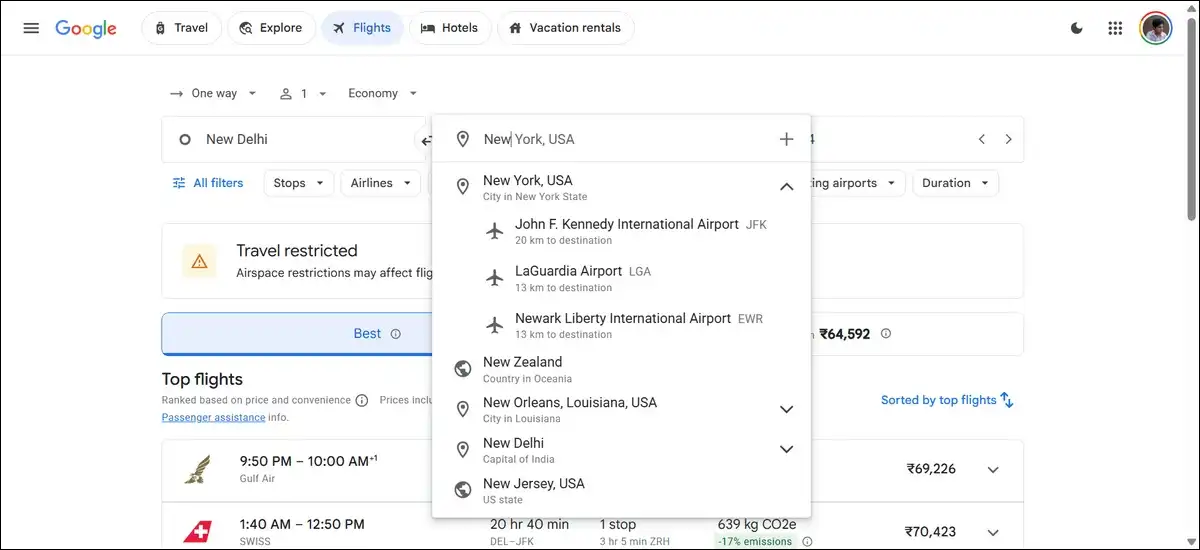
Type “Anywhere” as your destination to browse by budget. Google shows the cheapest routes worldwide on a map. Then you filter by price, airline, or duration.
This is ideal when your dates are set, but your destination isn’t. Better yet, you discover deals you’d never search for directly.
Set price alerts
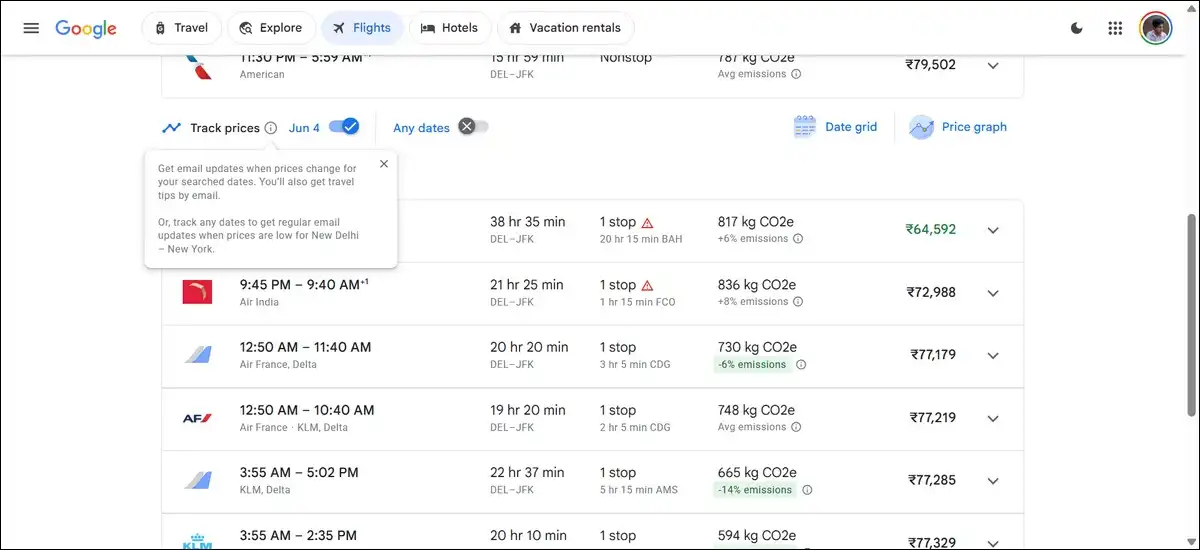
Turn on the Track Prices toggle below the search bar. Google then emails you when fares change. You can track exact dates or flexible dates.
Honestly, it’s the closest thing to passive saving. Set it once, then wait for the alert.
The 2026 Google Flights AI features you need to know
Google added powerful AI tools in 2025 and 2026. The biggest is Flight Deals, a conversational search bot. It understands plain-English trip ideas.
According to TechCrunch, Google expanded Flight Deals globally in November 2025. Before that, it launched in the US, Canada, and India in August.
Describe your ideal trip
Tip: the more detail you add, budget, trip length, nonstop only, the sharper the results.
How to use AI Flight Deals (with prompt templates)
Just type what you want in natural language. The more detail you give, the better the results. So skip the rigid date filters entirely.
Want a starting point? Here are copy-paste prompts that actually work:
| Goal | Prompt to type |
|---|---|
| Cheap weekend trip | “Cheap nonstop weekend trip from my city in October under $300” |
| Flexible warm getaway | “Somewhere warm in November under $600 with a beach” |
| Food-focused trip | “Week-long trip this winter to a city with great food, nonstop only” |
| Ski trip | “10-day ski trip to a world-class resort with fresh powder” |
In our experience testing AI flight tools, vague prompts return weak results. Specific budgets, trip lengths, and constraints sharpen the output dramatically. So treat the bot like a travel agent, not a search box.
The Basic Economy filter and its Southwest blind spot
Google now lets you exclude basic economy fares. This removes tickets with no carry-on or seat selection. It launched permanently in August 2025.
The filter works only for US and Canada flights. But it has one real gap worth knowing. It doesn’t exclude Southwest’s lowest Basic fares.
According to Thrifty Traveler, Southwest’s basic fares appear in both categories. So this filter won’t clean up your Southwest results. You’ll have to check those fares manually.
Baggage policy filter
The baggage filter shows what each fare actually includes. You see carry-on, checked bag, or personal-item-only fares. That way, you dodge nasty surprises at checkout.
A low fare often hides a baggage fee. Filtering early gives you honest price comparisons. In other words, you compare apples to apples.
AI Mode Canvas (beta)
Google is testing a full trip-planning panel. Canvas builds day-by-day itineraries with flights and hotels. It sits beside your search in a side panel.
This points to where travel search is heading. Soon you may plan an entire trip without ever leaving Google.
The data-backed booking calendar: when to book every trip
Book domestic flights about 39 days out. Book international flights at least 49 days ahead. These windows come straight from Google’s data.
Google analyzed fares across 4,000 markets between 2021 and 2025. As reported by Travel Noire, domestic flights are cheapest around 39 days before departure. International trips, on the flip side, favour 49 days or more.
Google Flights AI Flight Deals search box with a natural-language prompt for a cheap nonstop weekend trip:
Cheapest booking windows by trip type
Days before departure when fares are typically lowest. Source: Google.
The full booking window table
Different trips have different sweet spots. This table maps them all in one place.
| Trip type | Cheapest window | Low-price range |
|---|---|---|
| Domestic (general) | 39 days before | 23–51 days out |
| International (general) | 49+ days before | 49+ days out |
| Europe (from US) | 94 days before | 48+ days out |
| Mexico / Caribbean | 50 days before | 26–79 days out |
| Thanksgiving | 35 days before | 24–59 days out |
| Christmas / New Year | 51 days before | 32–73 days out |
| Spring Break | 43 days before | 28–61 days out |
| Summer (Jul–Aug) | 21 days before | 14–43 days out |
Why the “book on Tuesday” myth barely matters
So which day should you book? Honestly, it hardly changes the price. The data is clear and a little surprising. Stop obsessing over which day you buy.
Tuesday is technically the cheapest booking day. But the edge is tiny.
According to Google’s data via AOL, Tuesday is only about 1.3% cheaper than Sunday.
The real lever isn’t the day you book. It’s the day you fly and how far ahead you buy. So focus your energy there instead.
Advanced Google Flights Tricks That You Want To Know
These are the tactics that separate pros from casual users. They’re backed by data, not folklore. And each one targets real savings.
The fare bucket trick: search for one seat at a time
Search for a single seat, even when travelling in a group. Here’s why. Airlines sell seats in price buckets, and one sold-out bucket can raise the price for everyone.
Let’s break it down. Say only one cheap seat remains. If you search for four seats, all four jump to the next bucket.
So search for one seat first. Note the real low price. Then decide how to book the rest.
In our testing across busy US routes, splitting a four-passenger search into single-seat searches frequently exposed a lower per-seat fare. The gap widened most on near-full flights.
Layovers save 22%
Connecting flights are reliably cheaper than nonstops. The savings are bigger than most travelers expect. So use the stops filter to find them.
According to Google Flights data via AOL, travellers save 22% by booking a layover instead of a nonstop. That’s a meaningful cut on any fare.
Still, weigh the trade-off honestly. A long layover eats your day. A short one is often worth the savings.
Flying mid-week saves 13%
The day you fly matters far more than the day you book. Mid-week departures consistently cost less. Weekends, meanwhile, carry a premium.
Flying Monday through Wednesday beats weekend travel. Those days average about 13% cheaper than Friday, Saturday, or Sunday. Sunday, in fact, is typically the most expensive day to fly.
Open-jaw and multi-city itineraries
Fly into one city and out of another to save money. This is called an open-jaw itinerary, and Google Flights handles it under “Multi-city.”
It works wonders in Europe. Land in one capital, leave from another. You skip backtracking and often cut the fare.
Nearby airports
Check secondary airports near your destination. A short drive can unlock a much cheaper fare. Google lets you add nearby airports easily.
This is especially true in Europe and Asia, where budget carriers favour smaller airports. The savings can cover your ground transport and more.
Mixed-ticket warnings
The Cheapest tab sometimes shows mixed tickets. These combine flights from different airlines, and Google warns you must buy them separately.
So read those warnings carefully. Separate tickets mean no protection if one flight delays. The savings may not justify the risk.
Myths busted: what does not work on Google Flights
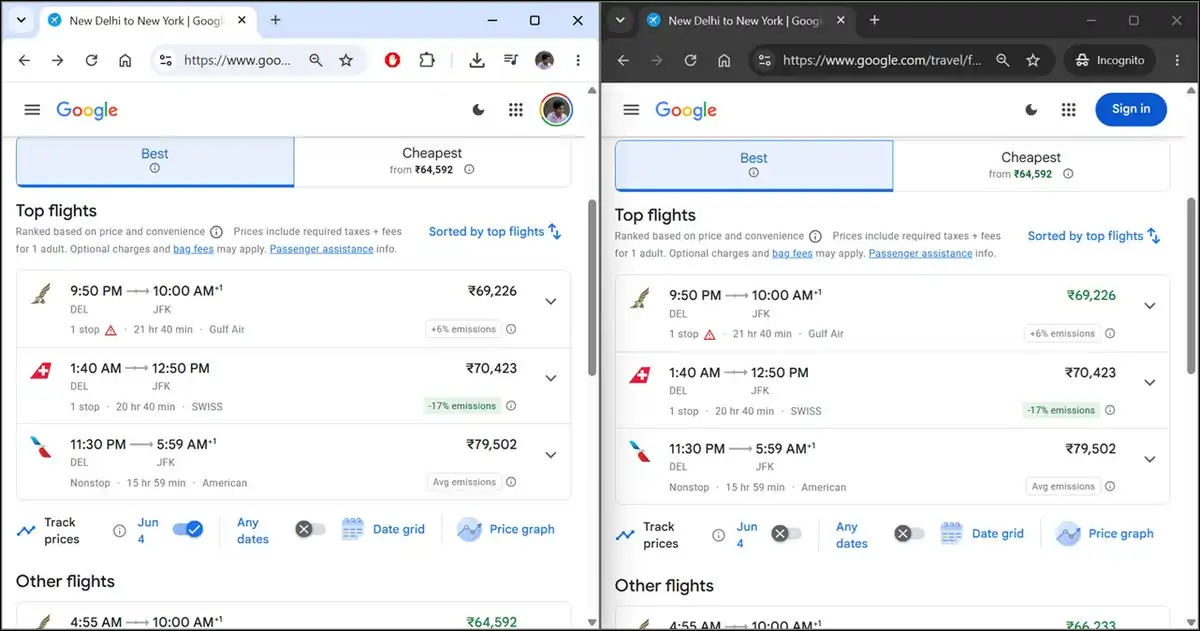
Incognito mode doesn’t get you cheaper flights. Clearing cookies doesn’t either. These persistent myths just waste your time.
Incognito mode and cookies
Browsing privately won’t lower your fare. The belief is understandable, but it’s wrong. Prices shift for a different reason.
According to Yopki’s 2026 analysis, there’s no evidence airlines raise prices based on your search history. When a price jumps, the cheapest fare class simply sold out. You weren’t targeted.
That said, incognito mode costs nothing. Use it for peace of mind if you like. Just don’t expect magic.
VPN location-switching
Switching your VPN location rarely delivers real savings. Some travellers swear by it, but the evidence is thin and inconsistent.
Pricing does vary by point of sale sometimes. The differences, though, are unpredictable. So don’t build your strategy around it.
Does checking repeatedly raise prices?
Searching the same route many times won’t punish you. Airlines don’t watch your individual searches. Fare buckets selling out create the illusion.
The myth survives because the symptom is real. Prices genuinely do rise as you watch. But the cause is inventory, not surveillance.
The smart tool-stacking workflow
Don’t rely on Google Flights alone. Instead, stack it with two or three other tools. Each covers a gap the others miss.
We find that Google Flights is best for speed and date flexibility. Kayak is better for finding cheaper fares from smaller agencies. Together, they cover far more ground.
Step 1: Shortlist with Google Flights
Start every search on Google Flights. Use the date grid to find cheap days. Lock in your route and rough dates.
Think of it as your research hub. Fast, clean, and accurate. It tells you whether a fare is low or typical.
Step 2: Catch deals with Going or Hopper
From there, use Going for mistake fares and deep discounts. Use Hopper for buy-or-wait timing predictions. Both fill gaps Google leaves open.
Going alerts you to rare deals before you even search. Hopper analyses price trends to advise on timing. So set alerts and let them work.
Step 3: Cross-check Kayak or Skyscanner
Next, confirm your price on a second platform. Kayak surfaces fares from smaller agencies. Skyscanner shines for budget carriers and international routes.
This step catches the occasional hidden deal. Five minutes here can save real money. So never book without one cross-check.
Step 4: Book directly with the airline
Finally, book on the airline’s own site when you can. You get better customer service and easier changes. Third-party bookings, by contrast, complicate refunds.
The table below shows when to use each tool.
| Tool | Best for | Use it to |
|---|---|---|
| Google Flights | Speed, date flexibility, predictions | Shortlist routes and dates |
| Going | Mistake fares, deal alerts | Catch rare discounts |
| Hopper | Price predictions, freeze feature | Decide buy or wait |
| Kayak / Skyscanner | Agency and budget-carrier fares | Cross-check the price |
2026 airfare context: why prices are up and how to adapt
Fares are sharply higher in 2026. A fuel-cost spike is the main driver. So smart timing matters more than ever this year.
Here’s a bar chart showing summer 2026 flight fares rising for domestic and Europe routes while Asia fares fall versus 2025:
Summer 2026 fares vs 2025, by route
Year-over-year change. Sources: Points Path, Kayak, KAYAK travel trends.
Domestic and international fares are surging
Summer travel got expensive fast. The increases hit both cash and award tickets. Europe, in particular, saw some of the steepest jumps.
According to the report published by The Points Guy, summer 2026 domestic round-trip economy prices run roughly 27% higher than last year. Award pricing climbed nearly 25% for domestic flights too.
August is the hidden cheap month
So when should you fly? Pick August to dodge peak prices. It’s the cheapest summer month, despite feeling like peak season. And the data backs this up.
August domestic coach fares run about 14% cheaper than July. International fares peak in June, then ease in August. Shifting your trip a few weeks helps.
Asia offers the best value
Look east for the best 2026 deals. While many regions rose, Asia fell. Value-driven travelers should pay attention.
In a market where most fares are climbing, falling routes are rare signals. When a region drops while others rise, that’s where flexible travellers should aim. Asia is the clearest example this year.
Final Thoughts
A 5-minute Google Flights routine that saves hundreds:
Build a simple routine and repeat it every trip. Consistency beats luck. So here’s the checklist that ties everything together.
The pre-booking checklist
Run these steps in order before you buy.
- Check flexible dates first using the price calendar.
- Try the AI Flight Deals bot for budget inspiration.
- Search for one seat to expose the true low fare.
- Apply the basic economy filter so prices stay honest.
- Turn on price alerts if you’re not ready to book.
- Cross-check the fare on Kayak or Skyscanner.
All told, it takes about five minutes. The payoff often runs into the hundreds.
When Google Flights is not the right tool
Skip Google Flights for some niche needs. It misses certain ultra-budget carriers. It also won’t proactively surface mistake fares.
For those, lean on Going or Skyscanner. Use the right tool for the job. After all, no single platform wins every time.
Your shareable quick reference
Keep the booking-window table handy. Book domestic around 39 days out. Book international 49 or more days ahead.
Then pair that timing with mid-week flights and flexible dates. Add a layover when the savings justify it. That combination beats the rising 2026 market.
People Also Ask For
Does incognito mode make Google Flights cheaper?
No. There’s no evidence that airlines or Google Flights raise prices based on your browsing history. When a price rises between searches, the cheapest fare class has usually sold out. Incognito mode costs nothing, so use it for peace of mind, but don’t expect lower fares.
When is the cheapest time to book a domestic flight?
About 39 days before departure, according to Google’s analysis of 4,000 markets from 2021 to 2025. The broader low-price range runs from 23 to 51 days out. Book international flights at least 49 days ahead.
What is the difference between the Best and Cheapest tabs?
The Best tab balances price with convenience like duration and stops. The Cheapest tab shows the lowest fare, even with long layovers, self-transfers, or third-party bookings. Always weigh the trade-offs before choosing the cheapest option.
Do flights with layovers really save money?
Yes. Google Flights data shows travelers save around 22% by choosing a layover over a nonstop flight. Use the stops filter to find them, but weigh the saving against the extra travel time.
Does the day of the week I book affect the price?
Barely. Tuesday is technically the cheapest booking day, but only about 1.3% cheaper than Sunday. The day you fly matters far more. Mid-week departures average roughly 13% cheaper than weekend flights.
What is the AI Flight Deals tool on Google Flights?
It’s a conversational search tool that accepts plain-English trip ideas instead of strict date filters. It launched in beta in August 2025 in the US, Canada, and India, then expanded globally in November 2025. The more detail you give it, the better the deals it returns.
Why are flights so expensive in 2026?
A fuel-cost spike pushed fares up sharply. Summer 2026 domestic round-trip economy prices run about 27% higher than last year. Flying in August, choosing mid-week dates, and considering Asia can soften the impact.