GeeksforGeeks Discrete Mathematics: Complete Guide, Topics & GATE Study Plan In 2026
Discrete Mathematics forms the foundation for algorithms, data structures, and formal reasoning in computer science. GeeksforGeeks gives free access to notes, quizzes, and previous-year questions.
In this guide, we check exactly what the platform offers in 2026. It maps topics to GATE needs. It offers a practical study plan too. Also, we flag gaps and show how to fill them for stronger results.
What Does Discrete Mathematics Actually Study and Why Does It Matter for Computer Science?
Discrete Mathematics examines structures with distinct, countable values instead of smooth continuous change. It focuses on objects like integers, graphs, logical statements, and finite sets.
Computer science relies on these structures every day. Algorithms process discrete steps. Databases manage relations between records. Cryptography depends on number theory and combinatorics. Machine learning models often use graph representations.
Why does this foundation affect your problem-solving speed?
Students who master discrete concepts solve coding problems faster. They recognise patterns in graph traversal or counting constraints without starting from scratch each time.
Take graphs, for example. They model networks, routes, and dependencies in real systems. Once you see the structure, many problems become clearer.
Discrete vs Continuous Mathematics
Key differences with practical examples
Discrete Mathematics
- Values: Distinct and countable (integers, graphs)
- Examples: Sets, Logic, Graph Theory, Combinatorics
- Used in: Algorithms, Cryptography, Databases, AI
- Key Objects: Integers, Graphs, Logical statements
Continuous Mathematics
- Values: Smooth and infinite (real numbers)
- Examples: Calculus, Real Analysis, Differential Equations
- Used in: Physics, Engineering, Signal Processing
- Key Objects: Curves, Functions, Limits
Discrete Mathematics deals with distinct, separate values — the foundation of computer science.
How Much Weight Does Discrete Mathematics Carry in Recent GATE CSE Exams?
Recent analyses of official papers show Discrete Mathematics contributing 5 to 8 marks in most years. These marks come from 3 to 4 questions tagged under DM topics.
The exact number varies slightly by year and how questions get classified. Coaching reports and GeeksforGeeks previous year pages list similar ranges for 2021 through 2025.
That said, the 5 to 8 mark figure counts questions whose main ideas fall under logic, sets, relations, combinatorics, or graph theory. Borderline cases sometimes shift categories.
In 2025, reports list 6 to 8 marks from questions of moderate to hard difficulty. Earlier years show comparable patterns around 7 marks on average. The weight stays steady enough to plan around it.
GATE CSE Discrete Mathematics Weightage
Marks trend (2021–2025)
Source: Official GATE papers & previous year analysis (2021–2025)
GATE CSE Discrete Mathematics Marks Trend
| Year | Approx. Marks | Number of Questions | Difficulty Trend |
|---|---|---|---|
| 2025 | 6–8 | 3–4 | Moderate–Hard |
| 2024 | 8 | 3–4 | Moderate |
| 2023 | 7–8 | 3–4 | Moderate–Hard |
| 2022 | 8 | 3–4 | Moderate |
| 2021 | 7–8 | 3–4 | Moderate |
These figures come from tagged questions in official papers, and they do not include every borderline case. Use them as a planning baseline rather than a guarantee.
What Topics Does the GeeksforGeeks Discrete Mathematics Section Actually Cover?
The main GeeksforGeeks Discrete Mathematics page acts as a hub. It lists major areas and points to sub-articles rather than containing full explanations in one place.
Core areas include mathematical logic, sets and relations, mathematical induction with combinatorics, Boolean algebra, optimisation techniques, ordered sets and lattices, probability theory, graph theory, special graphs, matching, vertex colourings, and group theory.
The hub page does not deliver deep explanations on its own. It provides short descriptions and directs readers to detailed sub-articles and last-minute notes. You have to navigate across multiple pages for complete coverage.
Sub-articles updated in mid 2025 cover functions in discrete mathematics, number theory applications, representing relations, and real-life applications. Each one focuses on definitions, formulas, and GATE-style examples.

Which Specific Concepts Appear in the GeeksforGeeks Last Minute Notes for Discrete Mathematics?
The Last Minute Notes page, updated August 26, 2025, organizes high yield formulas and properties for quick revision. It targets GATE aspirants who need rapid recall.
Propositional and predicate logic receive detailed treatment. The notes list operators, truth tables, De Morgan’s laws, and rules of inference. They include examples of tautologies and contradictions.
Set theory and relations cover operations, closures, equivalence relations, partial orders, Hasse diagrams, and lattices. Formulas for power set cardinality and Cartesian product size appear clearly.
Combinatorics includes permutations, combinations, binomial expansion, and inclusion-exclusion. The notes provide direct formulas without lengthy derivations.
Group theory covers basic definitions, subgroups, and cyclic groups. Graph theory receives concise treatment with properties of complete graphs and connectivity.
Functions receive only brief mention in the introduction. Recurrence relations and generating functions do not appear as dedicated sections. Readers must locate those in separate subarticles or external sources.
How Fresh Are the GeeksforGeeks Discrete Mathematics Resources in 2026?
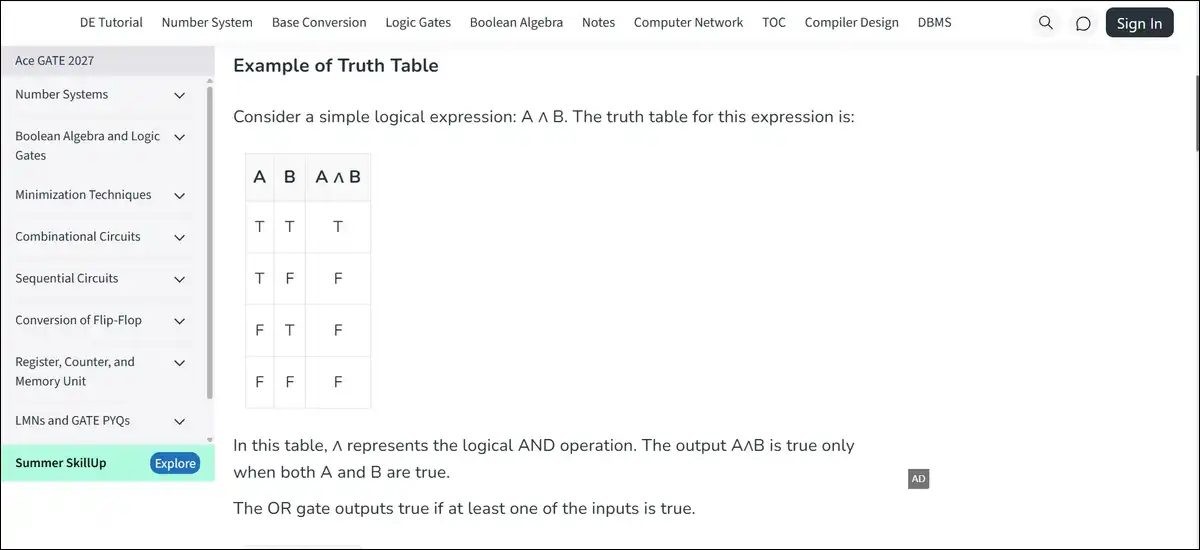
Most core pages carry 2025 update dates. The main tutorial hub shows September 1, 2025. The Last Minute Notes page shows August 26, 2025. Several sub-articles on functions, relations, and applications show July or August 2025 dates.
The previous year questions page remains active with data through GATE 2025. This recency supports reliability for current exam cycles.
Older video content from GeeksforGeeks YouTube channels still appears in searches. Text pages receive more frequent refreshes than video playlists.
What Practice Resources Does GeeksforGeeks Provide for Discrete Mathematics?
GeeksforGeeks hosts a dedicated Discrete Mathematics PYQ quiz containing 206 questions. The quiz draws from previous GATE papers and allows topic-wise or full attempts.
A separate previous-year questions page compiles marks distribution tables and question links for the past five years. It shows consistent 3 to 4 question patterns.
The broader GeeksforGeeks practice platform includes coding problems that apply graph algorithms and combinatorial logic. These bridge theory to implementation.
The 206 question quiz covers a wide range of difficulty levels and repeated concepts. It does not replace solving full-length mock tests from official or other coaching sources. Use it for targeted revision after initial learning.
Is the GeeksforGeeks Discrete Mathematics Material Enough on Its Own for GATE Preparation?
GeeksforGeeks supplies strong coverage of high-yield GATE topics in an accessible format. The combination of hub, last-minute notes, and quiz supports efficient revision for students already familiar with basics.
It covers the main topics well in a free format. Still, some areas need extra help from elsewhere. Navigation across scattered sub-articles requires extra effort. Depth on recurrence relations and advanced algebraic structures remains lighter than in dedicated textbooks.
Interactive exercises and step-by-step proof walkthroughs appear less frequently than in paid video courses.
Students who need visual explanations or extensive practice problems often supplement with external videos or books. Those preparing only for GATE find the exam-focused shortcuts and PYQ integration sufficient for core scoring.
Pros and Cons of GeeksforGeeks Discrete Mathematics Resources
| Aspect | Pros | Cons |
|---|---|---|
| Cost | Completely free | No structured paid support or doubt sessions |
| GATE Alignment | Strong PYQ focus and shortcuts | Less emphasis on proof rigor |
| Freshness | 2025 updates across pages | Some video content older |
| Practice | 206 question quiz + coding integration | Limited interactive drills per topic |
| Structure | Clear topic cards and formula sheets | Content scattered across multiple pages |
| Depth on Advanced Topics | Good on graphs and logic | Lighter on recurrence and generating functions |
How Should You Build a Realistic Study Plan Using GeeksforGeeks Resources in 2026?
A focused plan spreads effort across four to six weeks depending on your starting level. It prioritizes high weight topics first while building revision habits.
Start with foundations in week one. Focus on propositional and predicate logic plus sets and relations. Read the main hub descriptions. Work through the Last Minute Notes truth tables and laws. Attempt 40 to 50 questions from the PYQ quiz on these topics. Spend extra time drawing Hasse diagrams by hand.
Move to combinatorics and counting in week two. Cover permutations, combinations, inclusion-exclusion, and binomial theorems. Use the formula sheets in Last Minute Notes. Solve mixed counting problems. Link concepts to simple coding tasks such as counting valid sequences on the practice platform.
Tackle graph theory and special graphs in week three. Study graph types, traversals, Eulerian and Hamiltonian properties, matching, and colouring. Review the dedicated sub-articles. Practice drawing and analysing small graphs. Attempt all graph-related questions in the 206-question quiz.
Handle Boolean algebra, lattices, groups, and revision in week four. Complete Boolean minimisation and lattice properties. Review group basics. Revisit weak areas from earlier weeks using Last Minute Notes. Take at least two full mixed quizzes. Analyse mistakes against the marks distribution table.
Add a fifth week if time allows. Include recurrence relations from external sources if needed for algorithm analysis. Solve full-length GATE mocks that include discrete sections. Track accuracy on 5 to 8 mark blocks.
Adjust the timeline based on your current comfort level. Students weak in logic may need an extra week on week one topics. Those comfortable with graphs can compress week three.
Here’s a 4-week GeeksforGeeks Discrete Mathematics study plan with topic boxes and quiz milestones marked:
4-Week GeeksforGeeks Discrete Mathematics Study Plan
Optimized for GATE CSE 2026 Preparation
Foundations
- Propositional & Predicate Logic
- Sets, Relations & Hasse Diagrams
- → 40–50 PYQ Questions
Combinatorics
- Permutations & Combinations
- Inclusion-Exclusion Principle
- → Mixed Counting Problems
Graph Theory
- Graph Types, Traversals & Properties
- Eulerian, Hamiltonian & Coloring
- → All Graph PYQs
Revision & Mocks
- Boolean Algebra & Lattices
- Group Theory + Full Mixed Quizzes
- → 2 Full Mocks + Error Analysis
Adjust the timeline based on your current level. Use Last Minute Notes and the 206-question PYQ quiz for revision.
What Common Pitfalls Do Students Encounter in Discrete Mathematics for GATE?
Many students misapply quantifiers in predicate logic. They confuse universal and existential statements or mishandle negation placement. Always expand the statement into plain English before symbolizing.
Hasse diagram construction trips up candidates who forget to remove transitive edges or who draw incorrect covering relations. Practice with small posets and verify minimality step by step.
Counting problems with restrictions often lead to overcounting or undercounting. Break the problem into cases or use inclusion-exclusion explicitly rather than guessing formulas.
Graph isomorphism questions require checking degree sequences and adjacency patterns systematically. Avoid assuming two graphs match just because they look similar at first glance.
Quick Reference: Frequent Errors and Fixes
- Logic negation errors → Write the English meaning first, then apply De Morgan’s step by step.
- Hasse diagram mistakes → List all pairs, remove transitivity, then draw only covering relations.
- Combinatorics overcounting → Define cases clearly or apply inclusion-exclusion with documented terms.
- Graph property confusion → Verify definitions (Eulerian requires all even degrees and connectivity) before answering.
How Does GeeksforGeeks Compare with Other Discrete Mathematics Resources?
Different resources serve different primary needs. GeeksforGeeks excels for GATE-specific revision and free access. Other platforms offer deeper interactivity or broader theoretical treatment.
Comparison of Major Discrete Mathematics Resources
| Resource | Best For | GATE PYQ Focus | Interactivity | Recurrence Depth | Cost | Update Style |
|---|---|---|---|---|---|---|
| GeeksforGeeks | Quick GATE revision + quizzes | High | Medium (quiz) | Light | Free | Frequent text updates |
| Tutorialspoint | Structured multi page tutorial | Low | Low | Strong | Free | Stable |
| Codecademy | Beginner interactive practice | None | High | Medium | Freemium | Course based |
| Calcworkshop / Video Courses | Visual step by step explanations | Low | High (video) | Strong | Paid | Evergreen |
| Standard Textbook (e.g., Rosen) | Proof rigor and exercises | None | Low (book) | Strong | Paid | Edition based |
Choose based on your goal. GATE aspirants gain most from starting with GeeksforGeeks and adding targeted video explanations for difficult proofs. Students seeking research-level depth benefit more from textbooks and university notes.
What Real World Applications Does Discrete Mathematics Power Today?
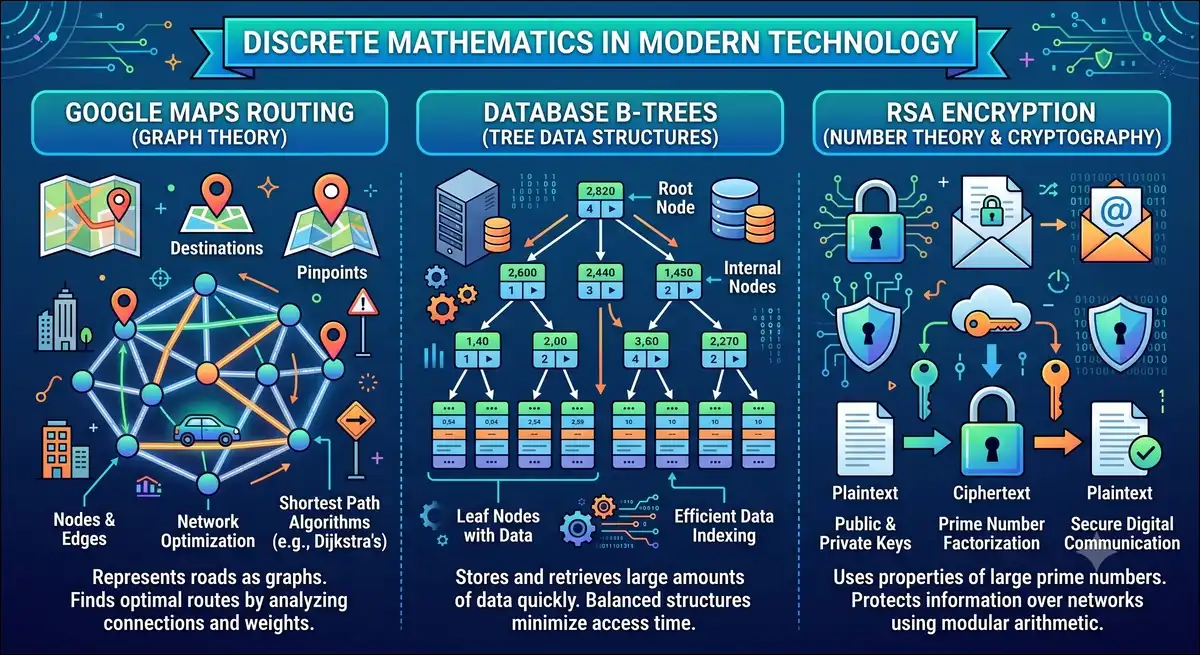
Discrete structures appear in everyday technology systems. Graph algorithms route delivery vehicles and map applications. Combinatorial optimisation reduces costs in logistics and scheduling.
Cryptographic protocols rely on modular arithmetic and prime properties studied in number theory sections. Database query optimisation uses relational algebra rooted in set theory.
Formal verification tools check software and hardware correctness through logical reasoning. These tools prevent costly bugs in safety-critical systems.
The percentage improvements cited in articles come from specific implementations. The 15 percent figure comes from one logistics case. Results vary with problem size, data quality, and integration with other systems. They illustrate potential rather than guaranteed outcomes across all deployments.
Which Topics Receive Lighter Coverage in GeeksforGeeks and How Can You Fill the Gaps?
Recurrence relations and generating functions receive less emphasis in the main hub and Last Minute Notes. These concepts matter for algorithm complexity analysis in later GATE or interview questions.
Advanced algebraic structures such as rings and fields appear only briefly. Students targeting deeper theory or specific electives should consult a textbook chapter on these.
Hands-on coding bridges remain implicit rather than guided. After learning graph algorithms in theory, implement BFS, DFS, and shortest path variants directly on the GeeksforGeeks practice platform to reinforce retention.
Recommended supplements for common gaps include short video explanations from reliable GATE channels for recurrence and the Master Theorem. Add one dedicated chapter from a standard discrete mathematics textbook for full algebraic structures. Use university open courseware problem sets with solutions for extra proof practice.
What Comes After You Finish the Core GeeksforGeeks Material?
Once you complete the hub, notes, and quiz, move to mixed topic mocks. Focus on timing and accuracy under exam conditions.
Apply concepts in small projects. Build a simple graph visualizer or a logic expression simplifier. These exercises turn abstract formulas into working tools.
For campus placements or further studies, review how discrete topics appear in technical interviews. Graph problems and counting puzzles appear frequently in coding rounds.
Track your progress against the marks distribution table. If your mock scores on discrete sections stay below target, revisit specific sub articles and quiz attempts rather than rereading everything.
Final Practical Takeaways for Preparation
GeeksforGeeks supplies a current, free, and exam-aligned starting point for Discrete Mathematics. The 2025 updates and 206-question quiz add immediate value for GATE candidates.
Success depends on consistent navigation across the hub and sub-articles plus deliberate practice on weak spots. Supplement recurrence and proof depth from other sources when needed.
Start with the logic and sets sections this week. Attempt the corresponding quiz questions right after. Build the habit of linking each concept to both exam patterns and simple coding applications.
Your score on the 5 to 8 mark discrete block improves most through targeted repetition and error analysis rather than passive reading. Use the platform’s resources as the core and add external pieces only where your personal gaps appear.