Aside AI Browser Launches With 297/300 Benchmark Score, Targets Comet and Dia Users
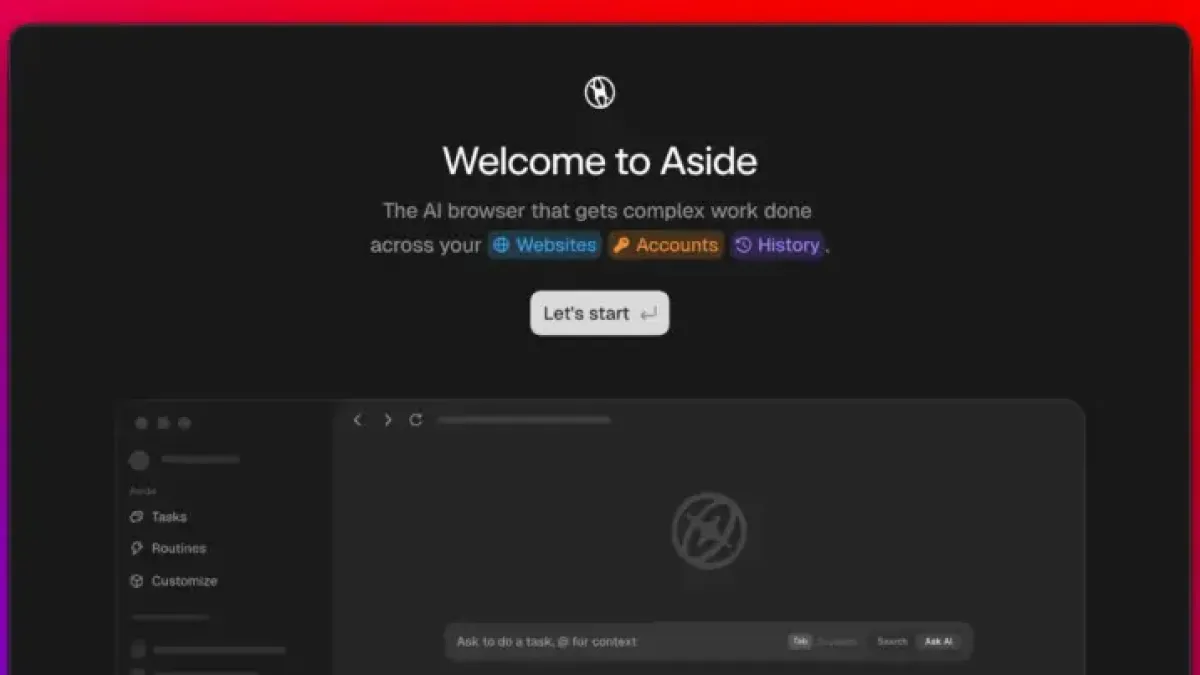
A new AI-native browser called Aside launched June 23, posting open-sourced agent benchmark results showing 297 correct completions out of 300 tasks on the Online-Mind2Web suite — a standard evaluation for web-based AI agents — and outperforming Anthropic’s Claude Fable on that measure.
Founder Jun announced the release on X, citing vertical tab navigation, local data encryption, and compatibility with existing AI subscriptions including Claude and ChatGPT as core features.
What Sets It Apart
Unlike rival AI browsers that layer AI features onto a conventional browser shell, Aside ships from version 1.0 with command-line interface (CLI) support, Model Context Protocol (MCP) integration — a standard that lets AI Tools communicate with external apps — and a REPL (read-evaluate-print loop) interface for developers who want to control browser agents directly from a terminal.
That combination positions Aside less as a general-purpose browser and more as a tool for users already embedded in AI and developer workflows.
The browser also supports account-bound web research, a task category where most AI browsers struggle. Contributor Chanhee demonstrated a workflow using OpenAI’s Codex in which Aside logged into X, searched a topic, filtered hundreds of posts and replies, and returned a structured summary — all without manual copy-pasting.
Privacy and Setup
During setup, Aside prompts users to set a local encryption password before any browsing data moves anywhere. It then offers to import history, cookies, and bookmarks from Safari, Comet, and ChatGPT Atlas.
Credentials used by the agent during task execution remain on-device, the company said. Users Can connect their own Claude or ChatGPT subscription or opt into Aside’s built-in plan, which draws on multiple frontier models.
Agent Design
The browser’s agent handles tasks across multiple Open Tabs and uses popover approval prompts — small on-screen notifications asking the user to confirm before the agent proceeds — to prevent sessions from stalling when the user isn’t watching.
That design addresses a common complaint with browser agents: they often pause mid-task after missing a notification, leaving workflows incomplete for hours.
Early Performance Issues
Early testing flagged some rough edges. The browser ran sluggishly with only a few tabs open during initial use on an M2 MacBook Air, which also ran warmer than usual — though a concurrent background process may have contributed to both issues.
The development team is actively addressing early feedback. They confirmed they are working to make new tabs open at the top of the vertical tab list rather than the bottom, a default that current users flagged as disruptive.
They also reset usage limits for subscribers on paid plans after discovering a bug in the limit-calculation system.
Context
Aside enters a crowded field. Perplexity’s Comet and the Dia browser have both drawn attention in recent months as AI-native alternatives to Chrome and Safari, though neither has displaced conventional browsers in daily use for many early adopters.
The Online-Mind2Web benchmark, developed by researchers at Ohio State University, evaluates how accurately AI agents complete real web tasks including search, form submission, and multi-step navigation across live sites.